Priced by the Token: The Quiet Economics Behind Every Answer
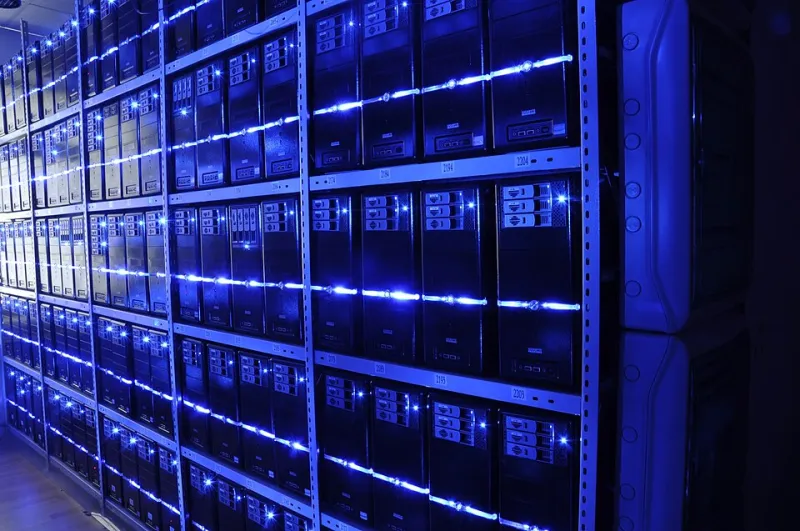
Photo: BalticServers.com, CC BY-SA 3.0, via Wikimedia Commons
Somewhere in a data center outside Phoenix, a rack of GPUs just fired up to answer a question about sourdough starters. The user paid nothing. The provider, almost certainly, lost money.
The economics of AI inference remain one of the least examined stories in American technology. While headlines chase model releases and benchmark records, the actual machinery of delivering an answer — the electricity, the silicon, the engineering labor spent shaving milliseconds — determines which AI companies survive the decade and which become cautionary tales told at industry conferences in San Francisco.
The Anatomy of a Single Query
Consider what happens when a knowledge worker in Chicago asks a chatbot to summarize a forty-page report. The prompt is tokenized, routed to available hardware, and processed through billions of parameters — often in multiple passes for long context. Each generated token requires a forward pass across the network. Multiply that by millions of simultaneous users and the arithmetic becomes sobering.
Industry estimates suggest that serving a frontier-class model can cost anywhere from fractions of a cent to several dollars per interaction, depending on context length, output volume, and hardware utilization. The variance is the story. A poorly optimized deployment might burn ten times the compute of a well-tuned one for identical output quality.
GPU hours are the raw currency. High-end accelerators command hourly rates that would make a Manhattan parking garage blush, and they run hot — literally. Cooling infrastructure in desert-adjacent states like Arizona and Nevada has become a competitive moat, with water and power contracts increasingly shaping where AI companies build.
Why Token Pricing Looks the Way It Does
The per-token pricing model familiar to any developer with an API key is not an arbitrary convention. It is an attempt to map a billing unit onto a cost unit. Tokens correlate roughly with compute, which correlates roughly with expense.
But the mapping is imperfect. Long prompts that sit in cache cost less to reprocess. Batched requests amortize hardware more efficiently than single-stream traffic. Providers who master these levers can undercut competitors while protecting margins; those who cannot are effectively subsidizing their users.
Three cost levers dominate modern inference strategy:
- Quantization and distillation — shrinking models to run cheaper hardware with minimal quality loss
- Speculative decoding — using smaller models to draft tokens that larger models verify, accelerating generation
- Caching and routing — sending easy queries to cheap models and reserving premium compute for hard problems
Each lever represents real engineering investment, and the gap between sophisticated operators and everyone else widens monthly.
The Margin Squeeze Arrives
The uncomfortable truth emerging across the industry is that inference, not training, is where AI economics will be decided. Training is a one-time capital event. Serving is a perpetual operational bleed. A model that costs nine figures to build can be rendered unprofitable by a competitor who serves a comparable experience at half the cost.
This dynamic explains the rapid proliferation of smaller, task-specific models. It explains why providers are aggressively tiering their offerings. And it explains the quiet commoditization underway: when the underlying capability converges, the durable advantage goes to whoever runs the cheapest, fastest, most reliable serving stack.
For enterprises procuring AI services, the implications are practical. Contracts negotiated today should anticipate price deflation, because costs per unit of intelligence are falling fast. Locking into premium pricing for commodity inference is a strategic error that finance teams will inherit.
What Happens Next
The companies that thrive will not necessarily be those with the largest models. They will be the ones treating inference as a discipline — measured, optimized, and priced with the rigor of an airline managing fuel costs. The rest will discover that in AI, generosity is a slow-motion liquidation.
The next time an assistant answers a question in under two seconds, consider what just occurred: a global choreography of silicon, electricity, and optimization, priced at a fraction of what it cost three years ago. The trajectory points toward zero. Getting there profitably is the defining business problem of this era.